
Landlord mortgage guide
Buy-To-Let Mortgages Explained
Understand how buy-to-let mortgages work, what lenders check and how rental income, deposit and landlord costs affect the application.
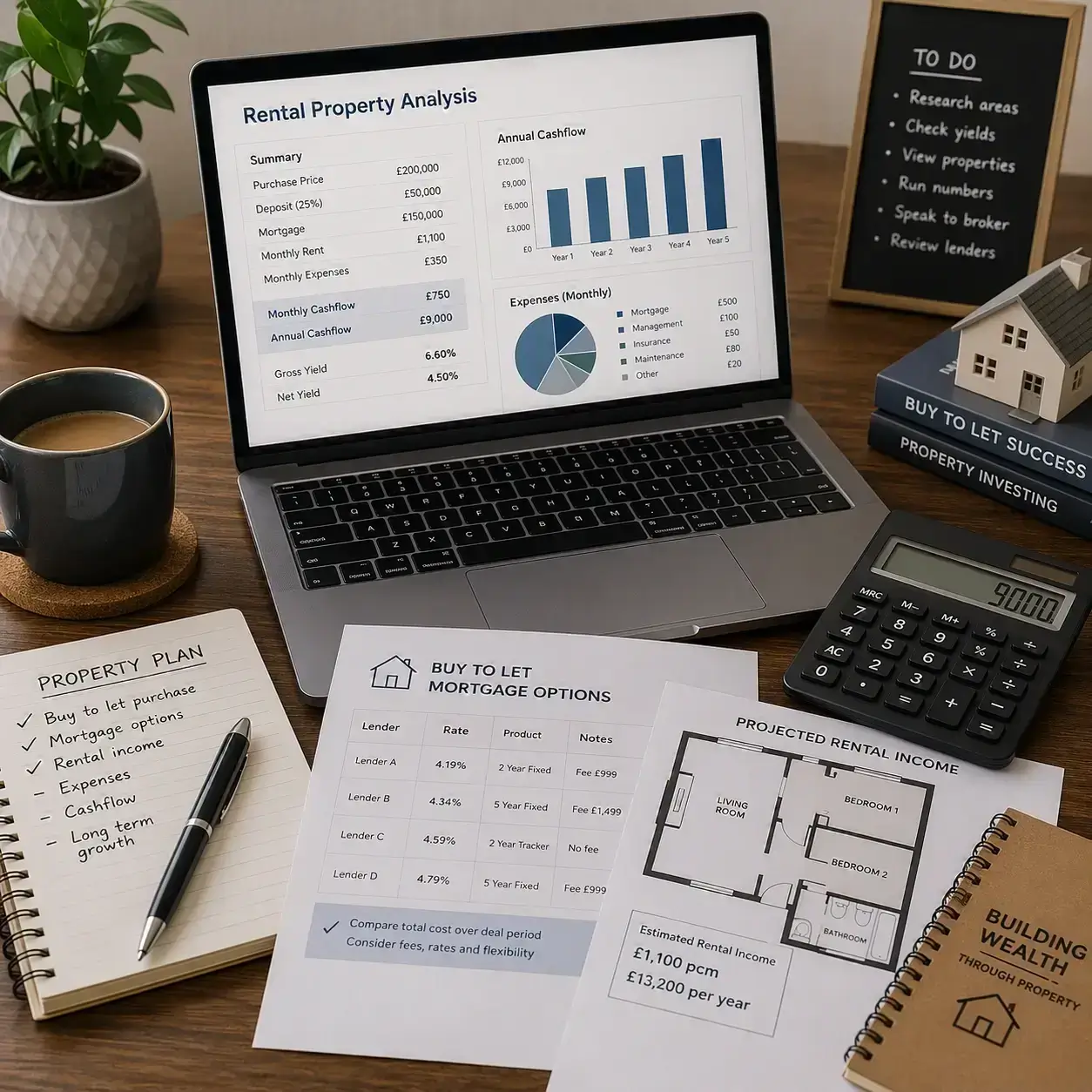
Buy-to-let lending is assessed differently from a residential mortgage, with rental income and landlord costs playing a key role.
Useful reminder: A rental property needs planning beyond the mortgage payment.
Quick answer
How does a buy-to-let mortgage work?
A buy-to-let mortgage is designed for a property you intend to rent out rather than live in yourself. Lenders usually assess the expected rental income, your deposit, credit profile, property type and sometimes your personal income. Most buy-to-let mortgages are arranged on an interest-only basis, although repayment options may be available. The rental income normally needs to meet the lender’s stress test, which checks whether the rent is high enough compared with the mortgage payment. Buy-to-let mortgages can involve higher deposits, different fees and extra tax considerations, so advice is important before committing.
Important: Your property may be repossessed if you do not keep up repayments on your mortgage.
Buy-to-let mortgages are for properties that will be let to tenants, not used as your main home.
Lenders usually test whether expected rent is enough to support the mortgage.
Buy-to-let deposits are often larger than residential mortgage deposits, depending on lender criteria.
Landlords should consider tax, insurance, maintenance, void periods, fees and possible rate changes.
Key points
Key takeaways about buy-to-let mortgages
Request a callback
Request a callback
Have a question about this guide? Leave your details and an adviser can talk you through the next step.
Main guide
What is a buy-to-let mortgage?
A buy-to-let mortgage is a mortgage for a property that will be rented out to tenants. It is different from a standard residential mortgage, which is designed for a home you live in yourself.
Because the property is being let, lenders usually place more focus on the expected rental income. They want to know whether the rent is likely to cover the mortgage payment by enough of a margin, based on their own stress testing rules.
How buy-to-let differs from residential lending
With a residential mortgage, affordability is usually based mainly on your personal income and outgoings. With buy-to-let, the rental income is often the key factor, although some lenders also require a minimum personal income or review your wider financial position.
Buy-to-let mortgages may also have different deposit requirements, interest rates, fees and repayment options. Many are arranged on an interest-only basis, meaning the monthly payment covers interest only and the loan balance remains outstanding.
This can support cash flow, but it also means you need a plan to repay the mortgage at the end of the term.
Your property may be repossessed if you do not keep up repayments on your mortgage.

What do buy-to-let lenders check?
Buy-to-let lenders usually assess both the property and the borrower. The exact approach varies, but rental income is usually central to the decision.
Lenders may review:
- expected monthly rental income
- property value and deposit size
- loan-to-value
- property type and condition
- your credit history
- your existing mortgage commitments
- whether you are a first-time landlord
- whether you already own a property
- your personal income, where required
- whether the property will be let to family or on a standard tenancy
A lender may ask for a rental valuation to confirm what the property is likely to achieve. This figure may differ from what an estate agent or letting agent suggests.
The rental income usually needs to pass a stress test. This means the rent must cover the mortgage payment by a set percentage, often using a notional interest rate chosen by the lender. The rules can differ depending on tax status, product type, fixed-rate period and whether you own personally or through a limited company.
If the rental income is too low, you may need a larger deposit or a different lender, or the borrowing amount may need to be reduced.

This is a simplified illustration. Rental stress tests and lender calculations can vary.
How much deposit do you need?
Buy-to-let mortgages often require a larger deposit than residential mortgages. The exact amount depends on the lender, property type, rental income, your experience as a landlord and the loan-to-value you need.
A higher deposit may improve the range of options available, but it does not guarantee approval. The rental income still needs to fit the lender’s calculation, and the property must meet criteria.
Interest-only or repayment?
Many buy-to-let mortgages are interest-only. This means your monthly payments cover the interest, but the capital balance is not reduced. At the end of the term, the mortgage still needs to be repaid.
Some landlords use the sale of the property as a repayment strategy, while others may refinance or use other funds. It is important to understand the risks and have a realistic plan.
Repayment buy-to-let mortgages may also be available, but the monthly payments will usually be higher.
Tax and landlord responsibilities
Buy-to-let is not just about the mortgage. Landlords need to consider tax, insurance, safety requirements, maintenance, letting agent fees, licensing where applicable and possible periods without tenants.
Tax treatment can be complex, especially around mortgage interest, rental profit, capital gains tax and whether to buy personally or through a limited company. The Mortgage Hive can explain the mortgage side, but tax advice should come from a qualified tax adviser or accountant.
First-time landlords
Some lenders accept first-time landlords, while others prefer applicants who already own a residential property or have letting experience. If you are buying your first rental property, lender choice may be more important.
The lender may also look more closely at your personal income and overall financial position.
Common mistakes to avoid
A common mistake is assuming the rent alone means the mortgage will be approved. Lender stress tests can be stricter than expected.
Another mistake is not allowing for void periods, repairs, insurance and rate changes. A rental property can have months where income is lower than expected, so it is sensible to keep a financial buffer.
How The Mortgage Hive can help
The Mortgage Hive can help you understand buy-to-let mortgage options before you apply. We can review the property value, expected rental income, deposit, loan amount and lender criteria.
We can also explain how different lenders may assess the rental income and whether the numbers are likely to fit.
Choosing the right lender
Buy-to-let criteria can vary widely. Some lenders are more comfortable with first-time landlords, certain property types, higher loan sizes, portfolio landlords or limited company structures. Others may have stricter rental stress tests.
Choosing a lender that fits the property and your circumstances can help avoid unnecessary delays or declined applications.
Fee-free mortgage advice
The Mortgage Hive provides whole-of-market mortgage advice and does not charge a broker fee. We can help compare buy-to-let options and explain the mortgage process clearly.
What to do next
If you are considering a buy-to-let purchase, gather the expected rent, property value, deposit amount and details of your current financial position. If you already own rental property, details of your portfolio may also be needed.
Your property may be repossessed if you do not keep up repayments on your mortgage.
Useful questions to ask your adviser.
- How much deposit do I need for this buy-to-let property?
- Does the expected rent pass lender stress testing?
- Which lenders accept first-time landlords?
- Should I consider interest-only or repayment?
- How will my personal income affect the application?
- Are there different options for personal ownership and limited company ownership?
- What costs should I allow for beyond the mortgage payment?
MORTGAGE-READY STEP
WHAT IS A DECISION IN PRINCIPLE?
A Decision in Principle, sometimes called an Agreement in Principle or Mortgage in Principle, is an initial indication from a lender of what they may be prepared to lend based on information provided at that stage.
It can help you understand a possible budget and show estate agents that you have started the mortgage process. It is not a full mortgage offer and can still change once the full application, documents, credit checks, valuation and underwriting are completed.
Fee-free mortgage advice
Don’t get stung, let The Mortgage Hive save you money.
- Free advice, nothing to lose
- Open, honest, straight-talking guidance
- Great friendly customer service
- Online, over the phone, or face to face
- Residential mortgages
- Buy-to-let mortgage advice
- Self-employed income
- Adverse credit cases
Speak to a mortgage broker before you apply.
Clear, friendly guidance with no pressure and no guesswork.
Lender access
Access to over 100 lenders.
We can help you explore options from a wide range of mainstream and specialist lenders, giving you a clearer view of what may be possible based on your circumstances.
Process map
How the mortgage advice and application process usually flows
This visual route map shows the usual stages from an initial conversation through to application, offer and completion.
We look at whether you are buying, remortgaging, moving home, investing or dealing with a more complex situation.
Income, outgoings, deposit or equity, credit history, property type and lender requirements are reviewed.
Suitable mainstream and specialist lenders are compared to see what may be possible based on your circumstances.
Documents are prepared, fees and repayments are checked, the application is submitted and lender questions are handled through to offer and completion.
WHY CLIENTS CHOOSE THE MORTGAGE HIVE
WHY CLIENTS CHOOSE THE MORTGAGE HIVE.
Mortgage decisions can feel confusing, especially when lender criteria, affordability and rates all need to be considered. The Mortgage Hive helps make the process clearer, with fee-free mortgage advice and access to a wide range of lenders.
FEE-FREE ADVICE
We do not charge an advice fee for mortgage advice, so you can speak to us before deciding your next step.
WIDE LENDER ACCESS
We can compare options from over 100 mainstream and specialist lenders, depending on your circumstances.
CLEAR GUIDANCE
We explain the options, costs and criteria in plain English, without pressure or jargon.
FLEXIBLE SUPPORT
Speak to us online, over the phone or face to face, whether you are buying, remortgaging or exploring buy-to-let.
Sources checked
Trusted sources used to support this guide.
These sources support the educational content and should be checked again when the page is reviewed or updated.
FAQs
Common buy-to-let mortgage questions.
What is a buy-to-let mortgage?
A buy-to-let mortgage is designed for a property you intend to rent out to tenants. It is assessed differently from a residential mortgage, with lenders usually focusing on expected rental income, deposit, property type and sometimes your personal income.
How much deposit do I need for buy-to-let?
Buy-to-let mortgages usually require a larger deposit than residential mortgages. The exact amount depends on the lender, property type, rental income, your circumstances and the loan-to-value. A larger deposit may increase lender options, but approval is not guaranteed.
Do lenders use rental income for affordability?
Yes, rental income is usually central to a buy-to-let mortgage assessment. Lenders normally use a stress test to check whether the expected rent is enough compared with the mortgage payment. The calculation and required rent can vary by lender.
Can I get a buy-to-let mortgage as a first-time landlord?
Some lenders accept first-time landlords, while others prefer applicants with property ownership or landlord experience. Lender criteria can vary, so it is worth checking before applying. Your personal income, deposit, credit history and property details may also matter.
Are buy-to-let mortgages interest-only?
Many buy-to-let mortgages are arranged on an interest-only basis, meaning the monthly payment covers interest but does not reduce the loan balance. Repayment options may also be available. If you choose interest-only, you need a plan to repay the mortgage later.
Can I live in a property with a buy-to-let mortgage?
A standard buy-to-let mortgage is intended for a property let to tenants, not for you to live in as your main home. Living in the property without lender permission could breach the mortgage terms. You should explain your plans clearly before applying.
Can The Mortgage Hive help with buy-to-let mortgages?
Yes. The Mortgage Hive can help you compare buy-to-let mortgage options, understand rental stress testing and prepare for the application. We do not charge a broker fee, and we can explain the mortgage side clearly.
Our reviews
Trust should be easy to verify.
Read what clients say about The Mortgage Hive on Google, then speak to us before you decide what to do next.
Buying to let?
Check your buy-to-let mortgage options
Buy-to-let mortgages need careful planning because rental income, deposit, lender criteria and landlord costs all matter. The Mortgage Hive can help you understand the numbers before you apply.
Important mortgage information
Your home may be repossessed if you do not keep up repayments on your mortgage. Mortgage approval is subject to status, affordability and lender criteria.
Interest rates, fees and criteria can change, and early repayment charges may apply. This guide is for general information only and is not personal financial advice.